

| Your high school years can be some of the most important years of your life. It is important that every student makes the most of every opportunity they get during these years to ensure they finish their school years successfully. The following page will outline the basic steps students should undertake during their studies both at home and at school, as well as tips on exam preparation and techniques. For any questions, tips or advice from other current students, please visit our Community Forum.
|
|
QUICK LINKS –Studying |
 |
| –At Home | |
| –At School | |
| –Exam Preparation | |
| –Sources
|
|
STUDYING (in general)
| WHEN SHOULD I START STUDYING |
| Start NOW!!! |
| Here’s 6 steps to get you started… |
| 1. Decide that time-management is important – it enables you to satisfy, efficiently and effectively your needs and wants. |
| 2. Evaluate your study needs – requirements for each subject in terms of assignments, difficult of subject, etc…. |
| 3. What are you doing now – analyse your current time usage, where does your time go? |
| 4. Plan a new timetable. What is the purpose of a timetable? EFFICIENCY, ORGANISATION, CONCENTATION. |
| 5. Revise that timetable – after 1 to 2 weeks. |
| 6. Set us a special pre-exam timetable. |
| PREPARING TO STUDY |
Find a good place to study. This means a desk with nothing on it except what you need for the task you are going to work on. Move everything out of the way. You want to concentrate on one thing: STUDYING. Have a regular time and place for studying. Make sure you have the following:
|
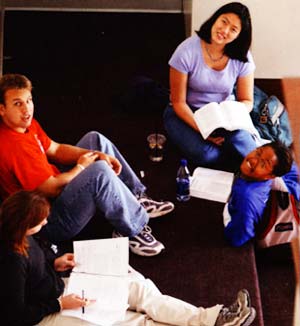
| APPROACHES TO LEARNING FOR HSC STUDENTS |
|
| STUDY HINTS |
| 1. LISTEN ACTIVELY in class, using four steps – TILE (tune-in, investigate, listen, estimate). |
| 2. Make active NOTES, in your own words, in class, highlighting points by using headings, sub-headings, underlining and diagrams (avoid sentences). |
| 3. Re-read your notes as soon as possible and make a SUMMARY on the back of the page. |
| 4. A SUMMARY must be brief and must act as a key to recalling other material. |
| 5. Make a further brief OUTLINE of the summary, listing only key headings. |
| 6. REVISE the material several times, well in advance of exam time. |
| 7. Make a REVISION STUDY TIMETABLE. |
| 8. When REVISION, use active methods – questioning: looking at how the topic is organised; pretending to explain it to someone else; imagining the exam questions you might get; etc… |
| 9. PERSONALISE the material (give it your frame of reference and your associations). |
10. Use memory tools for complex lists, such as:
|
| 11. When READING (notes from textbook) read with a purpose. |
| 12. Have your notes in clearly labelled folders in a quiet, well-lit, comfortable, tidy and friendly area |
| 13. Practice a RELAXATION technique daily and start revision sessions with it. |
| 14. Be aware of NEGATIVE thoughts. Allow the thought to finish. Then repeat a positive statement to yourself. If a negative thought persists, then use your positive statement as a daily GOAL or AFFIRMATION. |
| 15. Five weeks before EXAMS are due, make a new revision timetable, allocating times to cover various topics and subjects. |
| 16. Now REVISE by using tour notes, summaries and outlines together. |
| 17. Avoid last minute CRAMMING as much as possible. Keep your sleep, relaxation and recision in balance. |
| 18. ANTICIPATE the EXAM PAPER format (using past papers) |
| 19. IN THE EXAM, read actively (underline key words; allocate time to various parts of the paper; write rough point outlines of essay answers) |
| 20. When writing ESSAYS, have a clear INTRODUCTION, BODY and CONCLUSION. State how you will answer the question and what points you intend to make. (Don’t just tell a story or list your information without regular reference to the question.) Use your information to SUPPORT your points. |
| 21. Keep and use your sense of humour. |
| TIMETABLE / SCHEDULE | ||||||||||||||||
| With a timetable or schedule, you will be able to keep track of work that needs to be done. You may order the tasks which have more priority over others and it will help you keep focus on what you have to be doing. It is important you keep track of every single task you have. | ||||||||||||||||
| You may have a very open timetable, which just states the task given and the due date, or you may have a very specific timetable which is very detailed and tell you exactly what needs to be done on what day during a certain time period. | ||||||||||||||||
| With a timetable you will be able to manage time effectively, allowing you to have more freedom while achieving your tasks. | ||||||||||||||||
Example of an Open timetable:
|
||||||||||||||||
STUDYING (at school)
| LISTENING |
Listening can sometimes be the hardest skill of all to learn and to refine. Think about it. When your teacher is bawling you out for something, how often do you actually listen? Most of the time your brain has gone off duty while your mouth is saying ‘Yeah, yeah, yeah, I know’. How often, when you’re bored in class, have you drifted off into a daydream, only to come back to consciousness and realise that you haven’t heard a thing? Listen consciously, actively, to everything that’s said to you. Even though you won’t like some of it, you will remember it. Try listening for ten minutes to a conversation on the bus, or perhaps between your parents. Then sit down and write down the major points of the conversation. This will begin to fine tune your listening skills so that even boring material delivered in class is recalled easily.
|
| TAKING NOTES |
Especially when we’re young, we think we’ll remember information just by listening. This may be true to a certain extent, but it won’t earn you the highest HSC score you deserve. In class, while you’re reading, while you’re studying, take notes constantly. This doesn’t mean writing down everything you hear or read. It means taking down the most important points in your own words. At the end of the day, read through your notes and revise them. Mark key points wind important facts with a highlighter. File the notes in organised folders.
|
STUDYING (at home)
| HOW TO IMPROVE YOUR MEMORY |
|
EXAM PREPARATION
| All year round >> Six weeks before the exam >> Two weeks before >> Just before >> In the exam room |
All Year Round
Six Weeks Before The Exam
Two Weeks Before
|

| HOW TO RELAX ON EXAM DAY |
|
SOURCES
- http://www.how-to-study.com
- “Succeed In Exams, Triumph In Tests” by Jean Robb and Hilary Letts (Hodder Headline Australia)
- Sunday Life from The Sunday Telegraph, April 2
- http://www.e-study.com
- “Focus on HSC: parents and student lecture” by EdAssist, University of Sydney
- “Excel HSC Survival Guide” 2001 Edition